“In today’s economy, prosperity flows from two streams:
the goods we ship and the expertise we export.”
Trade – Exports and Imports Part 2
In Trade Exports and Imports Part 1 of 2 I provided you with a snapshot of Canada´s performance using a 3-year average convering the years 2022 to 2024. These were the most current full year numbers available from Statistics Canada.
I noted that ~77% of merchandise exports went to the United States and ~49% of merchandise imports were received from the United States. I also noted that approximately ~53% of serices exports went to the U.S. while ~58% services imports were received from the U.S..
Readers who read that post quickly grasped the fact that Canada depends too heavily on the United States for trade which has created a very difficult economic situation for our country now that the U.S. has opted to abandon international trade rules that have governed world trade for the better part of 75+ years.
I concluded that post by indicating that I would discuss Canada´s trade numbers in greater detail in this post. I also noted that I would be speaking about the so called 15 Free Trade Agreements Canada covering 51 countries Canada has signed over the past 20+ years.
Making Sense of Canada´s Trade Data
In the sections that follow I will be incorporating numbers and percentages calculated using trade data from Statistics Canada. In particular I will be using agregate export and import data covering 5 years – from 2020 to 2024.
Why did I use this time period and aggregate data? The time period was the most complete data currently available from Statistics Canada. Using aggregate data based on 5 years provides an overall objective presentation of trade numbers.
While great care has been taken to source the right numbers, develop the calculations and present that data in a usable format for everyday readers, there is always a chance that a particular number or calculation may be off somewhat. While Statistics Canada provides a wealth of useful data, easily extracting and interpreting that data from their website is not ´´a walk in park´´. That said, I am quite confident with the numbers I will be presenting.
Canada´s 15 Trade Agreements as of 2025
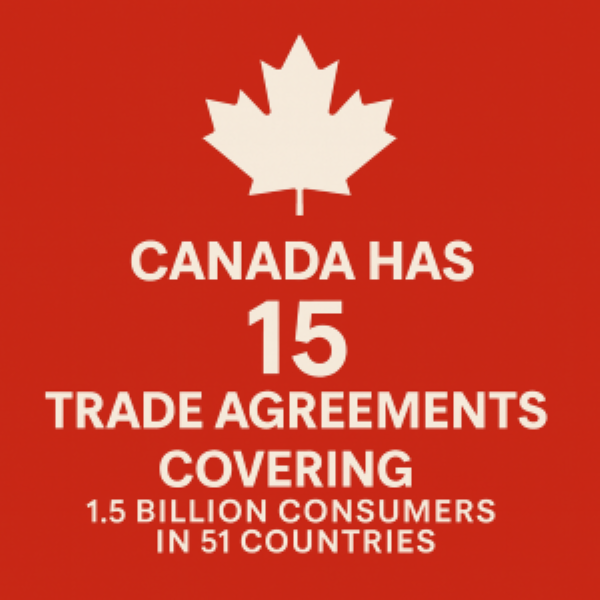
According to the Trade Commissioner Service (TCS) Canada currenlty has 15 Free Trade Agreements covering 51 countries with a total population of ~1.5 billion people. The following link wiill take you to a Trade Agreements page that provides the acronym and descripton for each agreement.
Key Data Points
- Between 2020 and 2024 Canada exported ~$3.487 trillion and imported ~$3.425 trillion worldwide, resulting in an overall surplus of ~$62 billion.
- With respect to the 51 countries covered under Canada´s 15 trade agreements, Canada exported ~$3.162 trillion and imported ~$2.656 trillion resulting in an overall surplus of ~$506 billion.
- You may ask, what´s the relationship between the two surplus numbers ~$62 and ~$506 billon? In simple terms, Canada ran a total trade deficit of ~$440 billion importing merchandise from countries outside of the 51 covered under Canada´s trade agreements. For example, China, India, etc.
- It´s extremely important to highlight a key fact. Had Canada not amassed a trade surplus of ~$966 billion with the United States between 2020 and 2024, our country would not have had any surplus whatsoever. In all likelihood, we would have incurred a very sizeable trade deficit.
You may find the following quite enlighting with respect to the 15 Canadian trade agreements:
- These agreements accounted for ~91% of Canada´s total trade exports and ~78% of the country´s trade imports.
- Canada achieved trade surpluses with 3 agreements and incurred trade deficits with 12 agreements.
- With respect to the 51 countries covered by these 15 agreements, Canada achieved trade surpluses with 12 countries and incurred trade deficits with 39 countries.
- With respect to the Canada, United States, Mexico Agreement (CUSMA), Canada ran a trade surplus of ~$966 billion with the United States and a trade deficit of ~$158 billion with Mexico.
- With respect to the Canada-United Kingdom Trade Continuity Agreement (Canada-UK TCA), Canada ran a trade surplus of ~$60 billion with the United Kingdom.
- With respect to the Canada-Ukraine Free Trade Agreement (CUFTA), Canada ran a trade surplus of ~$433 million with Ukraine.
- With respect to the Comprehensive Economic and Trade Agreement (CETA), Canada ran trade surpluses with 4 countries totalling ~$13 billion and trade deficits with 23 countries totalling ~$229 billion.
- With respect to the Canada-Europeon Free Trade Association Free Trade Agreement (Canada-EFTA FTA), Canada ran a trade surplus with 1 country totalling ~$10 billion and trade defiicts with 2 countries totalling ~$16.3 billion.
- With respct to the Comprehensive and Progressive Agreement for Trans‑Pacific Partnership (CPTPP), Canada ran trade surpluses with 3 countries totalling ~$2 billion and trade deficits with 4 countries totalling ~$82 billion.
- With respect to the Canada–Korea Free Trade Agreement (CKFTA), Canada ran a trade deficit ~$30 billion with South Korea.
- With respect to the Canada–Panama-Peru Free Trade Agreements (CPFTA) Canada ran a trade surplus with Panama of ~$1.7 billion and a trade deficit with Peru of ~$16.1 billion.
- With respect to the Canada-Chile Free Trade Agreement (CCFTA), Canada ran a trade deficit with Chile of ~$5.4 billion.
- With respect to the Canada-Israel Free Trade Agreement (CIFTA), Canada ran a trade deficit with Israel of ~$4.6 billion.
- With respect to the Canada-Honduras Free Trade Agreement (CHFTA), Canada ran a trade deficit with Honduras of ~$2.2 billion.
- With respect to the Canada-Costa Rica Free Trade Agreement (CCRFTA), Canada ran a trade deficit with Costa Rica of ~$2 billion.
- With respect to the Canada-Columbia Free Trade Agreement (CCOFTA), Canada ran a trade deficit with Columbia of ~$1.3 billion.
- With respect to the Canada-Jordan Free Trade Agreement (CJFTA), Canada ran a trade deficit with Jordan of ~$288 million.
The following link wiill open up a Trade Data pdf document that provides detailed trade numbers to support the facts I just listed.
Key Takeaways
If prosperity depends on countries exporting more than they import, Canada´s 15 trade agreements are not delivering the results needed. 12 out of 15 agreements are incurring systemic trade deficits.
It seems that successive governments, both Liberal and Conservative, focused primarily on the signing aspect of trade agreements and spent very little effort on putting the right structures in place to ensure those agreements would benefit Canadians. Harsh criticism? Yup!
With the United States opting to abandon international trade rules and the economic harm it has directed towards Canada, it is highly likely that Canada´s exports to the U.S. will shrink drastically over the next three years. As a result, Canada is certain to incur ongoing trade deficits within 5 years if it is unable to rapidly and dramatically increase exports beyond the U.S..
While the Carney government is making a focused effort to sign more trade deals with other countries on an expedited basis, I am doubtful that they will yield the results our country needs. If you already have 12 out of 15 agreements yielding systemic trade deficits, what evidence can the government provide to show that any new agreements will not result in systemic trade deficits as well.
The branding of agreements as Fair Trade Agreements or Free Trade Agreements is a useless and deceptive concept. You can´t have fair or free trade agreements when all signatories to these agreements use tariffs, quotas, unique specification requirements, unique inspection processes, etc. for the purpose of gaming trade agreement rules to their respective advantages. All countries, including Canada, are guilty of this practice.
If you have not done so already, please review my Legal Stuff page.