“When the broad middle participates, a country finds its balance.
When it stays home, others decide its future.”
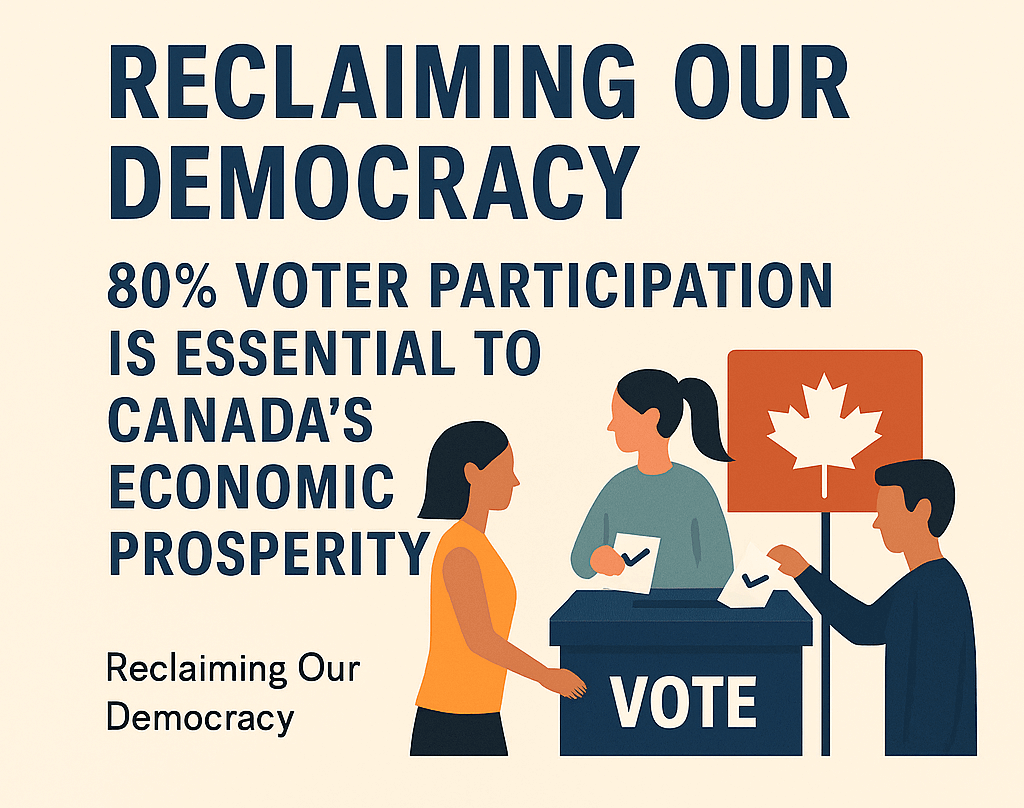
Reclaiming Our Democracy
80% Voter Participation Is Essential to
Canada’s Economic Prosperity
Canada’s future prosperity depends on the strength and participation of its broad middle — the millions of citizens who work, save, build, and sustain the country’s economic engine.
In Reclaiming the Middle, we explored how economic prosperity requires a revitalized middle class. In this post, I outline why economic prosperity also requires something deeper: a democracy capable of making long‑term, economically sound decisions.
Right now, Canada does not have that. This is not because Canadians are divided; it is because too many Canadians fail to vote.
For decades, voter turnout has hovered between 60% and 70%. That means one‑third of eligible citizens routinely sit out the very process that determines the policies shaping their jobs, taxes, housing, healthcare, and long‑term financial security.
A country cannot build lasting prosperity when a significant majority of its economic stakeholders are not fully represented in its political decisions.
If Canada is serious about rebuilding economic strength, then we must set a new civic ambition: no less than 80% of eligible Canadians should vote in every federal election. This is not idealism. This is economic strategy.
Economic Prosperity Requires Broad Participation
When turnout is low, the electorate becomes skewed toward narrower, more polarized groups. These groups often push for short‑term or ideological policies that undermine long‑term economic stability.
When turnout is high — especially among the broad middle — the political system is instead pushed to prioritize:
- Sustainable fiscal policy
- Predictable regulatory environments
- Long‑term infrastructure investment
- Housing affordability
- Workforce development
- Innovation and productivity
- Intergenerational mobility
These are the pillars of prosperity. They only rise when the broad middle of the electorate shows up to vote.
A democracy that represents only 60% of its citizens, while functional, will not produce policies that benefit 100% of its economy.
A Data‑Driven Look at Canada’s Turnout Challenge
Elections Canada’s historical data shows a clear pattern: turnout has been inconsistent for decades, with long stretches of disengagement punctuated by brief spikes of interest. (Source: Elections Canada)
Turnout Over Time (Selected Elections)
- 2008: 58.8% — the lowest turnout ever recorded
- 2011: 61.1% — modest recovery
- 2015: 68.3% — a major jump driven largely by younger voters
- 2019: 67.0% — slight decline from 2015
Elections Canada’s datasets also show that turnout varies sharply by age group, with younger Canadians consistently voting at much lower rates than older Canadians.
What This Means for Prosperity
Low turnout among younger and middle‑income Canadians has direct economic consequences. When fewer citizens participate, the political system becomes more vulnerable to the influence of highly organized special‑interest groups — environmental advocates, anti‑regulation advocates, and many others across the spectrum.
These groups often represent narrow priorities, and when turnout is low, their influence expands far beyond their actual share of the population. The result is:
- Policies shaped by concentrated advocacy rather than broad public interest
- Less focus on affordability, productivity, and long‑term economic competitiveness
- Long‑term investments overshadowed by short‑term political survival
- Parties catering to vocal constituencies instead of the broad middle
In other words: Low turnout amplifies special‑interest influence. And amplified special‑interest influence produces fragmented, low‑ambition economic policy.
A prosperous country requires a political system anchored by the broad middle — not by the loudest or most organized factions.
Electing Representatives — Not Just Leaders — Strengthens Economic Decision‑Making
Canada’s parliamentary system was designed to foster thoughtful deliberation and strong local representation. Modern elections have increasingly drifted toward leader‑centric campaigning, and this shift carries real economic consequences.
When voters choose parties based solely on leaders, Parliament becomes:
- Less independent
- Less regionally informed
- Less accountable
- More centralized
- More reactive to polls than to economic realities
When voters choose representatives — not mascots — the system changes in meaningful ways:
- MPs bring local economic knowledge to national debates
- Constituents gain a direct voice in policy formation
- Parties must adapt to regional economic needs
- Parliament once again becomes a forum for problem‑solving, not messaging
Economic prosperity requires a Parliament that understands the country — not just a leader who performs well on television.
High Turnout Is a Guardrail Against Economically Harmful Extremes
Low turnout amplifies the influence of:
- Fringe movements
- Single‑issue groups
- Ideological activists
- Highly polarized voters
These groups often push for policies that may feel emotionally satisfying at the expense of benefiting the broader economy.
High turnout — especially from the broad middle — acts as a stabilizer:
- It dilutes extremism
- It rewards moderation
- It forces parties to compete for moderate, economically pragmatic voters
- It increases the likelihood of evidence‑based policy
- It reduces the risk of sudden, destabilizing policy swings
Stable democracies produce stable economies. Stable economies produce rising prosperity.
A Prosperous Future Requires a Mobilized Middle
If Canada wants a stronger economy, then the broad middle of the electorate must reclaim its role as the steward of the country’s direction.
That begins with a simple, powerful commitment: Vote — not for a brand, not for a leader, but for a representative who understands your community’s economic reality.
Vote for:
- The candidate who listens
- The candidate who understands local industries
- The candidate who will challenge their own party when necessary
- The representative who sees prosperity as a shared, long‑term project
Canada does not need more slogans and polarization; it needs more citizen participation and the wise selection of members for parliament.
If we want a prosperous future, then the people who build that prosperity must also choose the leaders who shape it.
Your Vote Shapes Canada’s Economic Future
Prosperity is not automatic — it is built by the people who participate.
A prosperous Canada begins with a mobilized middle.
If you have not done so already, please review my Legal Stuff page.