
Foreign Talent Recruitment Strategy
A Core Enabler of Economic Prosperity
In Rebuilding Canada’s Economic Prosperity, I introduced seven enablers that must work together to strengthen productivity, competitiveness, and national capacity. This post focuses on the fifth enabler: Foreign Talent Recruitment Strategy.
To lay the groundwork for this post I would like to share two thoughtful articles that are quite illuminating. The first is from The Hub website and the second is from The Boreal Times.
Excerpts from The Hub website (The skilled trades shortage is now a threat to Canada’s economy—and we’re not doing enough to fill the gap):
- ´´…as a result of labour shortages, over 60 percent of manufacturers we surveyed said [they’ve] turned down or lost contracts.”
- “…Forty-three percent have postponed or cancelled capital investment. ´´
Excerpts from The Boreal Times website (Top countries with most engineers: Graduates & Investments in 2025):
- ´´In an era where technological innovation drives economic growth and societal progress, the question of which nations are best positioned to lead the charge often boils down to one key resource: engineering talent. The top countries with the most engineers aren’t just churning out degrees — they’re building ecosystems that nurture problem-solvers, inventors, and builders who shape everything from sustainable cities to artificial intelligence. ´´
- ´´This isn’t merely about numbers; it’s about how these countries invest in education to forge a workforce capable of tackling climate change, digital transformation, and beyond. ´´
To highlight the importance of The Boreal Times article I have adapted the data to produce the following chart.
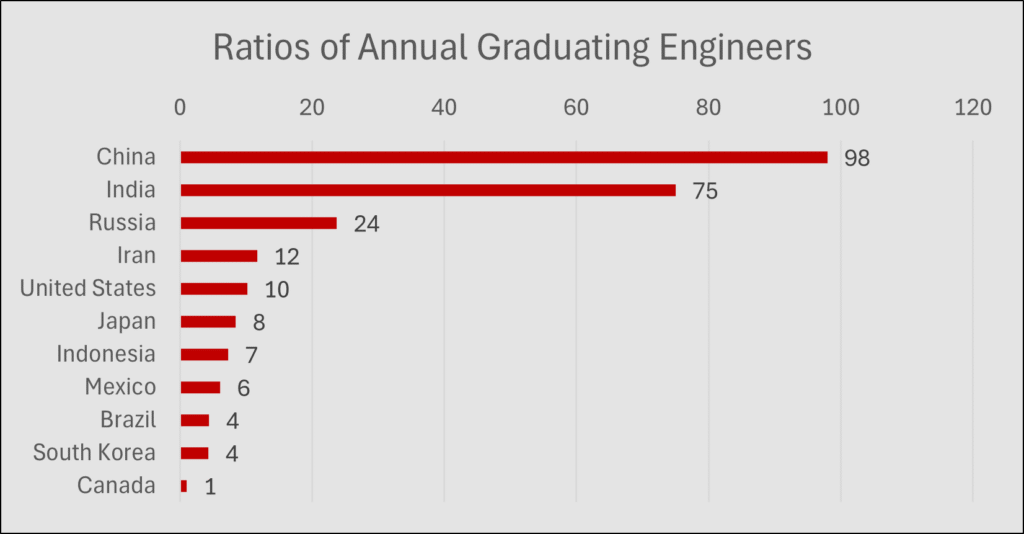
For every Engineer Canada graduates annually, other countries like China, Japan, South Korea are graduating far greater numbers. For example, for every Canadian engineering graduate there are 98 Chinese graduates. This highlights the scale challenge Canada faces: even with strong domestic training, the global competition for engineering talent is intense, and Canada’s output is modest by comparison.
National labour‑market projections indicate that annual demand for engineers exceeds the 16,000–20,000 graduates Canada produces each year — driven by retirements, infrastructure needs, and the growth of high‑value industrial sectors. Think about the aforementioned for a minute.
The shortages highlighted in these two articles suggest Canada’s workforce capacity is insufficient in relation to the scale of its economic ambitions. Even with a strong domestic Education and Skills Strategy, the country cannot train enough people quickly enough to meet the needs of high‑value, high‑potential industrial sectors. This puts our country at a distinct competitive disadvantage.
Canada cannot expand its high‑value industrial sectors, grow exports, or strengthen national security without the right levels of ongoing talent. While a focused Education and Training Strategy will certainly help contribute towards meeting Canada´s workforce needs, it must be twinned with a Foreign Talent Recruitment Strategy.
Complementing – Not Replacing – Domestic Training
Domestic education remains the foundation of Canada’s workforce. Foreign Talent Recruitment fills gaps that cannot be closed quickly enough through domestc education and training alone. The goal is to strengthen Canadian firms, accelerate innovation, and expand national capacity — not displace Canadians.
A strong Education and Skills Strategy and a strong Foreign Talent Recruitment Strategy must operate as a unified system. One builds domestic capability while the other accelerates national capacity where shortages are most acute.
Purpose of a Foreign Talent Recruitment Strategy
A Foreign Talent Recruitment Strategy is not a population‑growth exercise. Its purpose is to:
- fill critical skill gaps that limit national economic growth
- strengthen high‑value, export‑oriented industries
- support industrial, trade, defence, and economic strategies
- accelerate innovation and productivity
- ensure Canada can execute on its economic priorities
A strong Foreign Talent Recruitment Strategy must also guide Canada’s Immigration System. Immigration Policy must reflect national economic priorities, not operate independently of them. A coherent system requires immigration pathways that are explicitly aligned with workforce priorities rather than functioning as a parallel process.
When Foreign Talent Recruitment and immigration are aligned, Canada will attract the best, brightest and most capable people from around the world to support and share in our long‑term prosperity.
It is also possible that a well‑executed Foreign Talent Recruitment Strategy could make Canada a destination of choice for talented and industrious entrepreneurs. Countries that successfully attract highly‑skilled talent often experience stronger innovation ecosystems and more dynamic business formations.
Similarly, a strong talent ecosystem can make Canada a more attractive destination for Foreign Direct Investment. Many prosperous countries have leveraged talent concentration as a key driver of investment, technology transfer, and industrial expansion.
Designing a Targeted, Sector‑Aligned
Foreign Recruitment System
A modern Foreign Talent Recruitment Strategy requires:
- clearly identified national priorities
- accurate labour‑market forecasting across Canada’s high‑value, high‑potential industrial sectors
- alignment with industrial and trade strategies
- coordination across federal ministries, provinces, and employers
- streamlined pathways for priority occupations
- streamlined pathways for citizenship
- faster recognition of international credentials
Recruitment must be deliberate, not diffuse.
Regional and Sector‑Specific Needs
Labour needs vary across the country:
- Western Canada: energy, mining, forestry, industrial construction
- Ontario: automotive, advanced manufacturing, clean technology
- Quebec: aerospace and transportation equipment
- Atlantic Canada: oceans industries, shipbuilding, natural resources
A national strategy must coordinate these differences without imposing uniformity.
Accountability
Performance Tracking and Reporting
To ensure the system works, Canada needs simple, transparent, and manipulation‑resistant reporting. Tracking must reflect outcomes across:
- federal government ministries
- provincial governments
- private‑sector employers
- education and training institutions
Key indicators should include:
- workforce roles required by sector
- recruitment results by sector
- time‑to‑fill for critical roles
- placement of Canadians
- placement of foreign talent
These metrics, and others not identified, must be straightforward, accurate, and publicly reported. Without clear reporting, recruitment risks becoming symbolic rather than effective.
Integrating Foreign Talent Recruitment
with the Export‑Growth Architecture
Talent is a core input for industrial capacity, trade expansion, and national competitiveness. Recruitment must be embedded within a broader export‑growth architecture so that policies reinforce one another rather than operate in isolation.
Conclusion
A strong Foreign Talent Recruitment Strategy is essential for Canada’s long‑term prosperity. It complements domestic training, strengthens high‑value industries, and ensures Canada has the skills required to compete globally.
When aligned with the other enablers — Industrial Strategy, Trade Strategy, Defence Strategy, Education & Skills Strategy, Economic Strategy, and the Integrated Export‑Growth Architecture — it becomes a powerful tool for rebuilding Canada’s economic resilience.
If you have not done so already, please review my Legal Stuff page.