Identifying High-Potential Markets
Canada’s export profile remains heavily concentrated with one country, creating structural risk and limiting long‑term growth.
While diversification is the starting point, it does not happen on its own. It requires a practical, structured Trade Strategy that helps Canadian firms expand into more markets, deepen existing relationships, and pursue opportunities where alignment is strongest.
Part 2 outlines how Canada can identify high‑potential markets and apply a disciplined, region‑aware, sector‑aligned approach to export growth. The goal is not diversification for its own sake, but diversification achieved through deliberate actions that strengthen Canada’s position across multiple regions and sectors.
Maximizing Existing Agreements First
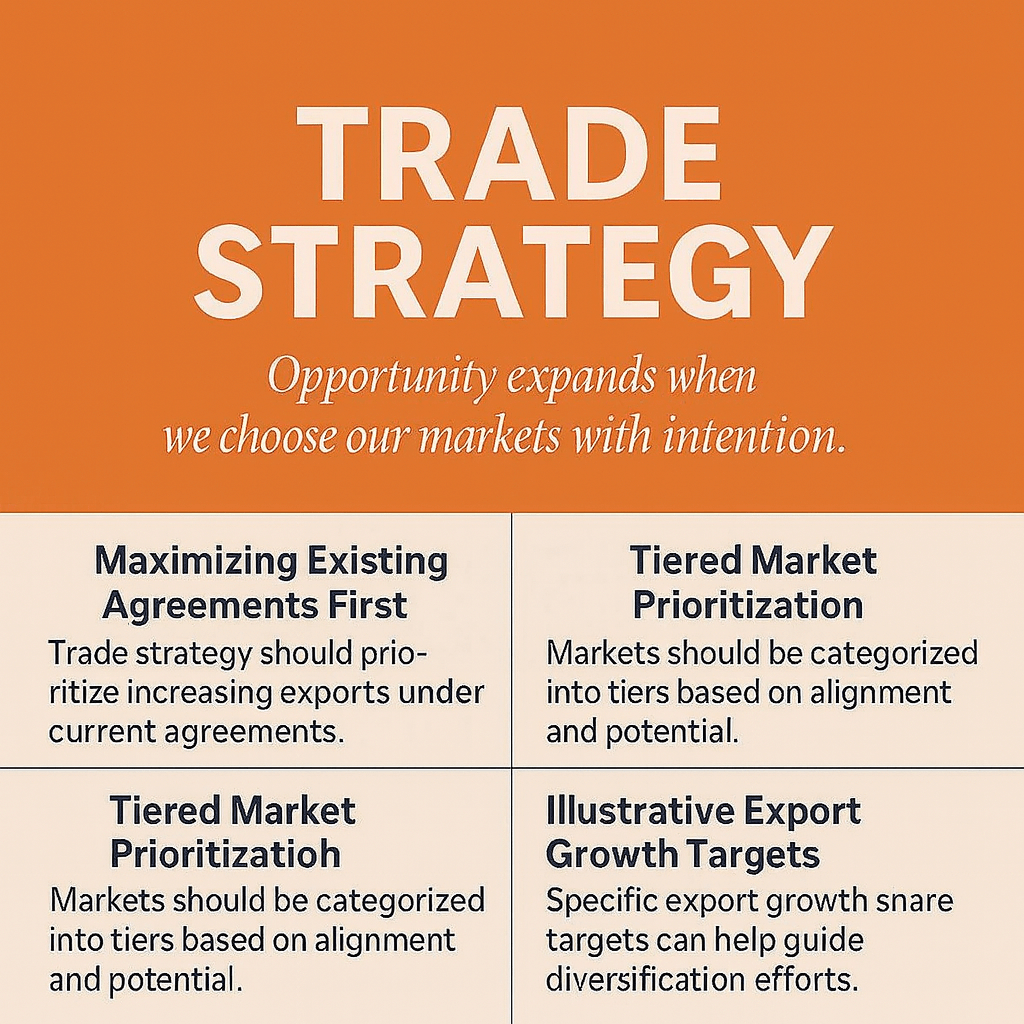
Given Canada’s current weak export performance, Trade Strategy should prioritize maximizing export growth under the existing 15 agreements before pursuing new ones.
This means:
- identifying which sectors have the strongest potential within each agreement
- addressing why Canada is running deficits with 39 of 51 partner countries
- ensuring that agreements are being used to their full potential
- aligning sector‑level capabilities with specific market opportunities
New agreements should be pursued second, not first — with one major exception.
The Exception: China and India
China and India represent nearly 3 billion people combined and will account for a large share of global demand growth in the coming decades.
Given their scale, Canada needs to prioritize developing comprehensive trade agreements with both countries on an expedited basis, while managing risks carefully. This is not about political preference; it is about economic reality.
Balanced Trade Agreements
Terms like “Free Trade Agreement” or “Fair Trade Agreement” are often used for branding purposes rather than substance.
Given Canada’s current deficits with most partner countries, a more accurate and useful term may be Balanced Trade Agreement — an agreement designed to support mutually beneficial, sustainable trade flows rather than one‑sided outcomes.
Tiered Market Prioritization
A tiered approach helps Canada focus its efforts:
- Tier 1: Markets where Canadian firms already have traction or strong alignment
- The 51 countries covered by Canada’s 15 Trade Agreements
- Tier 2: Markets with strong potential but requiring more groundwork
- China and India, for example
- Tier 3: Longer‑term opportunities where early engagement may pay off
- Singapore, for example
This structure helps Canada pursue diversification without spreading efforts too thinly.
Criteria for Market Selection
Market selection works best when guided by clear criteria, including:
- pace of export demand growth
- alignment with Canada’s industrial strengths
- regulatory compatibility
- geopolitical stability
- sector‑specific opportunities
- presence (or absence) of Canadian firms already operating in the market
Illustrative Export Growth Targets
Trade Strategy should identify export growth share targets for priority regions and countries. These targets are not predictions; they are directional markers that help align government efforts and signal to firms that new markets are worth exploring.
Illustrative targets include:
- reduce reliance on a single market from ~75% to 50% by 2035 by:
- increasing Europe’s share to 20–25%
- increasing Southeast Asia’s share to 10–15%
- increasing South Asia’s share to 5–10%
- increasing Latin America’s share to 5–10%
- increasing Africa’s share to 5%
Targets like these help ensure that diversification is intentional rather than incidental.
A Practical, Private‑Sector‑Centric Trade Strategy
Addressing Real‑World Barriers
A practical Trade Strategy focuses on the challenges firms face when entering new markets:
- regulatory complexity
- certification requirements
- financing constraints
- limited in‑market intelligence
Addressing these barriers often involves aligning existing tools so that support is timely and relevant.
Targeted Government‑to‑Government Engagement
Government engagement is most effective when linked to specific commercial opportunities or sector priorities. Missions abroad can help resolve market access issues and support firms as they build relationships.
Sector‑Level Monitoring and Encouragement
Trade Strategy may also require mechanisms that encourage export growth by sector. This can include:
- monitoring export performance by sector
- identifying bottlenecks early
- adjusting support tools when needed
These mechanisms help ensure that export growth is not left to chance.
Measuring What Matters
A practical Trade Strategy pays attention to measurable outcomes:
- Are more firms successfully entering priority markets?
- Are export volumes growing?
- Is Canada’s export profile becoming more diversified?
- Are priority sectors gaining market share in targeted countries?
Tracking Progress
Evaluating progress against export growth share targets provides a reference point for assessing whether Canada is moving toward a more diversified and resilient export profile.
Public Reporting on Progress
Public reporting on export growth progress can strengthen accountability and help Canadians see whether diversification efforts are working.
Continuous Feedback
Markets evolve, regulations change, and firms encounter new challenges. Building mechanisms to capture this information — and adjust strategy accordingly — helps Canada remain responsive.
Looking Ahead
With Trade Strategy in place, the external side of Canada’s prosperity framework becomes more complete. The next enabler — Defence Strategy — plays a critical role in strengthening and supporting both Industrial Strategy and Trade Strategy.
Defence Strategy expands advanced manufacturing capacity, accelerates technology development, and reinforces Canada’s credibility in global markets.
Together, these strategies help build the capabilities and partnerships required for long‑term economic resilience.
If you have not done so already, please review my Legal Stuff page.