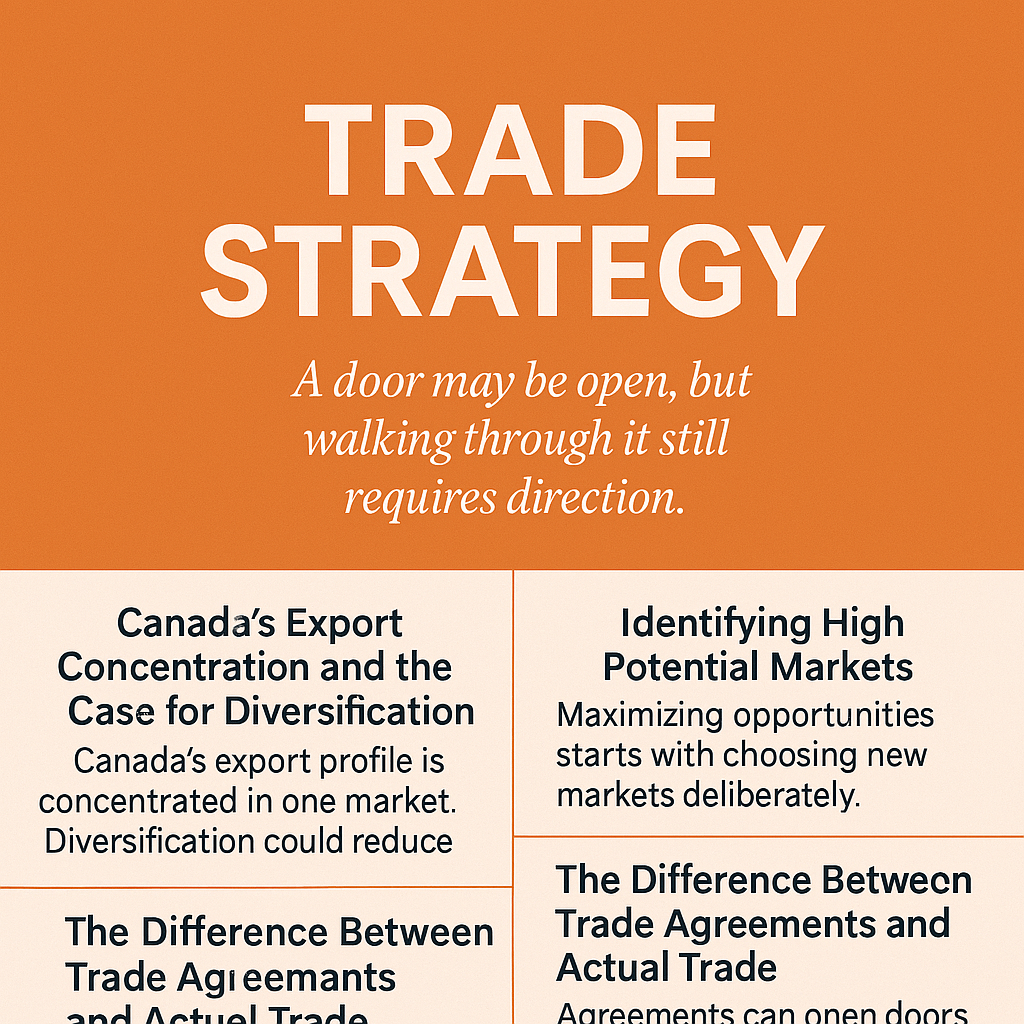
In Rebuilding Canada’s Economic Prosperity, I introduced seven critical enablers and noted that each would be explored in its own post. This post focuses on the second enabler: Trade Strategy.
A modern Trade Strategy exists for one purpose: to help Canadian firms succeed in global markets by identifying where opportunities are strongest and ensuring that government engagement supports real commercial outcomes.
Industrial Strategy and Trade Strategy must work hand in hand:
- Industrial Strategy identifies and strengthens the sectors where Canada can produce high‑value export goods and services.
- Trade Strategy determines where those exports can be sold, which countries offer the greatest potential, and whether trade agreements facilitate or hinder Canada’s ability to compete.
Industrial Strategy builds capability while Trade Strategy builds opportunity.
Why Trade Strategy Matters
Canada’s long‑term prosperity depends not only on what we build at home, but also on how effectively Canadian firms participate in global markets. A well‑designed Trade Strategy complements Industrial Strategy by:
- identifying markets where Canadian exports are most likely to succeed
- ensuring government‑to‑government engagement supports real commercial opportunities
- aligning trade agreements with the needs of private‑sector exporters
- helping exporters navigate the practical barriers to entering new markets
Trade Strategy is not about the number of agreements signed. It is about whether Canadian firms can grow exports in the markets that matter most.
Trade Agreements versus Actual Trade
Canada currently has 15 trade agreements covering 51 countries and roughly 1.5 billion potential customers. Yet export results do not reflect the scale of this network.
At present Canada:
- is running small to significant trade deficits with roughly 39 of the 51 countries covered by these agreements
- is running small to modest surpluses with about 10 countries
- has significant surpluses with only 2 countries
This pattern suggests that Canada’s current agreements are either not working correctly or not being leveraged effectively — likely a combination of both.
Trade – Exports and Imports Part 1 and Part 2 provide additional details.
Trade agreements can open doors, but they do not determine whether firms are ready to walk through them. Firms still need:
- the capabilities defined in Industrial Strategy
- the market intelligence, financing tools, and regulatory support required for successful market entry
- a clear understanding of where their products and services are most likely to succeed
There is a tendency to treat the signing of an agreement as an outcome in itself. In reality, agreements are tools — useful only when connected to a broader system that helps firms identify opportunities, navigate regulatory environments, and build the relationships required to export successfully.
A practical Trade Strategy ensures that agreements facilitate Canada’s ability to grow exports. This includes identifying where agreements are under‑used, where they may require adjustment, and where new agreements could support priority sectors.
The Case For Export Diversification
Canada’s Structural Trade Concentration
Canada’s export profile is more concentrated than that of most advanced economies. Roughly three‑quarters of merchandise exports go to a single market – the United States. This pattern has been manageable during periods of stability, but it creates structural exposure as global dynamics shift.
When two economies are deeply intertwined, even modest disruptions can create challenges on both sides. For Canada, this concentration means firms will feel disruptions more acutely simply because so much activity is tied to one destination.
Why Concentration Limits Industrial Strategy
A concentrated export profile limits the effectiveness of Industrial Strategy. Even if Canada strengthens its capabilities, the benefits may not fully materialize if most firms continue to rely on a single destination for export growth.
Concentration also makes it harder for firms to build the relationships, distribution channels, and in‑market experience needed to compete elsewhere. Over time, this reinforces a cycle where firms remain focused on familiar markets because alternatives feel too distant or too complex.
The Case for Time‑Bound Diversification Targets
Given these dynamics, Canada would likely benefit from setting clear, time‑bound export diversification targets. While targets do not guarantee outcomes, they do provide direction, help align government efforts, and signal to firms that new markets are worth exploring.
A more balanced export profile would reduce risk and create new opportunities for Canadian firms to scale in regions where demand is expanding more quickly than in traditional markets.
With the case for diversification established, the next step is to determine where Canada should focus its efforts. Trade Strategy Part 2 explores how Canada can prioritize regions, set directional targets, and build the mechanisms needed to help firms succeed abroad.
If you have not done so already, please review my Legal Stuff page.