“Prosperity is never the product of a single decision, but of many aligned efforts moving in the same direction.”
The Seven Enablers
Over the past several decades, Canada’s economic prosperity has quietly but steadily weakened. This decline is not the result of a single policy decision or economic shock. It reflects a set of structural issues that have accumulated over time and now shape the daily experience of Canadians.
In earlier posts — Canada Is No Longer Economically Prosperous, Canada’s National Debt and Accumulated Interest, How Federal Debt Impacts Provinces, Territories and Canadians, and Canada’s Current State of Trade – Exports and Imports — I outlined how rising debt, growing interest payments, stagnant productivity, and persistent trade imbalances have eroded the foundations of our prosperity. These pressures are no longer abstract. They show up in everyday life through:
- higher living costs
- affordability issues
- fewer secure, well‑paid jobs
- growing economic insecurity
- declining confidence in the future
At the centre of this trend is a simple structural reality: Canada’s export performance has not kept pace with what a resilient, prosperous economy requires.
When a country does not generate enough high‑value exports, it becomes financially strained, increasingly dependent on others, and more vulnerable to external shocks. The consequences are slower growth, weaker public finances, and fewer opportunities for households and businesses.
Reversing this trajectory requires more than short‑term adjustments. It requires a clear, coordinated national plan focused on rebuilding and expanding Canada’s capacity to produce and sell high‑value goods and services to the world.
While I do not have access to the Department of Finance’s internal modelling, the available data suggests Canada likely needs to increase its net exports beyond the United States to at least $250–$300 billion annually — and do so as quickly as possible. Achieving that scale of expansion will require deliberate, integrated action across multiple parts of the government and the economy.
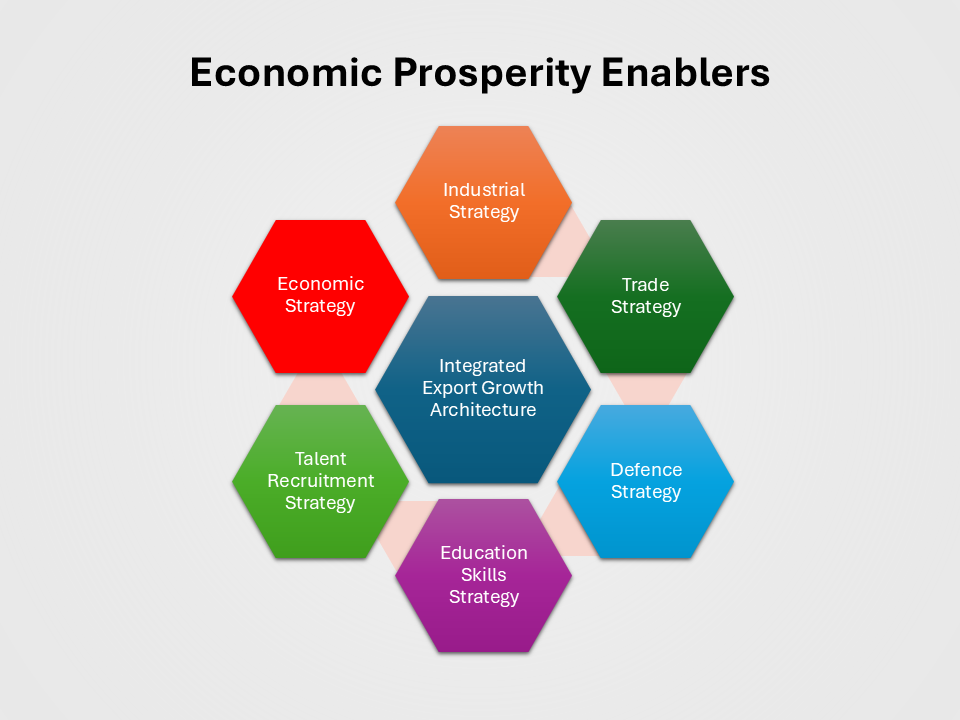
To support this effort, Canada needs a national plan anchored by seven economic prosperity enablers. These enablers are interdependent; progress in one requires alignment across the others. Together, they form a coherent framework for strengthening industry sectors, businesses and capabilities that drive high‑value export growth. I introduce them briefly here — each will be explored further in subsequent dedicated posts.
1. Industrial Strategy
Industrial strategy is not central planning or government “picking winners.” It is a practical, coordinated effort to identify and strengthen high‑value export sectors — the goods and services Canada can sell internationally at scale.
A modern Industrial Strategy focuses on areas where Canada has or can build competitive advantages and where global demand is strong. A more diversified industrial base will reduce Canada’s exposure to sector‑specific and geographic risks.
It also requires strategic partnerships with reliable foreign countries and companies. For example, the United Kingdom, Germany, Sweden, Japan, South Korea.
The overriding goal must be to expand Canada’s tradable exports and position Canadian firms to compete globally.
2. Trade Strategy
Canada’s Trade Strategy must shift from symbolic agreements to practical, results‑oriented trade expansion. Canada already has one of the world’s largest networks of trade agreements, yet our export performance remains weak.
The issue is not the absence of agreements; it is the absence of a focused strategy that identifies high‑potential markets which aligns with government and industry efforts to grow exports.
A modern Trade Strategy must prioritize markets where Canada can scale exports quickly, diversify beyond the United States, and build long‑term commercial relationships that support sustained growth.
Diversifying both markets and products is essential to reducing economic vulnerability and strengthening long‑term resilience. It must also ensure that existing agreements deliver balanced outcomes. Running systemic trade deficits under these agreements is not acceptable. If you have not done so already, you may want to read my posts on Canada’s Current State of Trade – Exports and Imports.
3. Defence Strategy
Defence Strategy is highly interconnected with Industrial Strategy, Trade Strategy and Economic Strategy. In its 2025 Budget, the Carney government committed $81.8 billion to modernize Canada’s military between 2026 and 2030. Achieving this modernization will require partnering with countries whose capabilities complement our own.
By directing procurement toward partners willing to expand imports of Canadian goods and services, Canada can turn defence modernization into a powerful engine of trade, industrial development, and long‑term economic resilience.
When aligned with Industrial, Trade and Economic strategies, Defence Strategy becomes a tool for strengthening both national security and economic prosperity.
4. Education and Skills Strategy
Canada’s education and training systems must prepare Canadians for the sectors that matter most to our economic future. This requires aligning universities, colleges, and training programs with national priorities in technology, advanced manufacturing, natural resources, clean energy, defence, and other high‑value fields.
A modern Education and Skills Strategy ensures Canadians can participate fully in the opportunities created by industrial and trade expansion. It also strengthens Canada’s ability to adapt to technological change in a highly competitive global marketplace.
5. Talent Recruitment Strategy
Canada cannot meet its economic objectives through domestic talent alone. Strategic immigration must be used as an economic tool to accelerate capacity in key sectors.
This means attracting global expertise that complements Canadian talent and fills critical gaps in engineering, advanced manufacturing, technology, research, and other high‑value fields.
A targeted Talent Recruitment Strategy strengthens domestic firms, accelerates innovation, and supports the growth of export‑oriented industries.
6. Economic Strategy
Economic strategy must reinforce Industrial and Trade strategies — not work at cross‑purposes.
Canada’s policies on Domestic Investment, Foreign Direct Investment, Tax Competitiveness, Infrastructure, Innovation, and Regulation all influence the country’s ability to grow high‑value exports.
A coherent Economic Strategy ensures these policies support, rather than hinder, the development of globally competitive sectors. This includes creating conditions that attract capital, accelerate innovation, and enable Canadian firms to scale.
When economic policy is aligned with industrial and trade priorities, it becomes a catalyst for export‑driven growth.
7. Integrated Export–Growth Architecture
The first six enablers described what Canada must strengthen. The seventh explains how these efforts must be coordinated.
An Integrated Export–Growth Architecture provides a clear framework for how federal ministries, crown corporations, and agencies involved in export and industrial development can operate as a coherent system.
It clarifies roles, reduces duplication, and ensures that programs, policies, and investments reinforce one another. Most importantly, it ensures that the previous six enablers are executed in a coordinated manner to achieve maximum effect.
Without this architecture, even well‑designed strategies risk becoming fragmented and highly ineffective.
Conclusion
Taken together, these seven enablers offer a practical way to understand how Canada can rebuild the foundations of long‑term prosperity. Canada’s economic challenges are significant, but they are not insurmountable.
Strengthening our prosperity requires a deliberate, coordinated effort built around these seven enablers. Each plays a distinct role, and together they form a system capable of rebuilding Canada’s capacity to compete and succeed globally.
In the posts that follow, I will examine each enabler further and outline how each can contribute to a more resilient and prosperous future for Canada.
If you have not done so already, please review my Legal Stuff page.