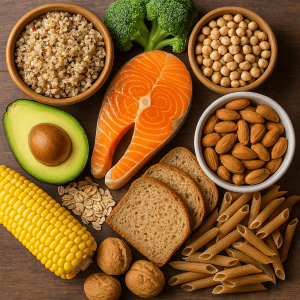
“Follow‑through most of the time, not all of the time, is key to success.”
Nutrition & Consumption – Part 1
A Practical Framework for Long‑Term Health
In my previous post, Mindset & Resolve, I explained that long‑term health begins with the internal commitments we make to ourselves — clarity, discipline, and consistency. This post builds on that foundation by focusing on the practical side: the daily choices that turn that mindset & resolve into meaningful action.
We live in a world overflowing with nutrition advice — miracle diets, conflicting rules, and promises of effortless results. Most of it is noise.
Sustainable health comes from something far simpler – consistently consuming the right mix of quality foods and liquids and understanding how your daily choices shape long‑term outcomes.
This post brings together the principles I’ve used for more than 25 years. It’s not a diet, a trend, or a rigid system. It’s a practical framework built on clarity, discipline, and long‑term consistency.
Nutrition Is Simpler Than Most People Think
Despite the complexity of modern nutrition discourse, the fundamentals remain straightforward:
- Eat mostly whole, minimally processed foods.
- Maintain a balanced mix of macronutrients.
- Drink mostly healthy liquids that support hydration and health.
- Be consistent more often than not.
Not perfection. Not extremes. Just thoughtful, repeatable habits.
And while this post focuses on macronutrients, it’s worth noting that micronutrients (vitamins and minerals) are naturally covered when you eat a whole‑food diet. You don’t need complicated supplementation to meet your needs.
A Balanced Macronutrient Framework
For active individuals, a commonly accepted macronutrient distribution looks like this:
- 50% mostly non‑processed carbohydrates
- 30% protein
- 20% healthy fats
This ratio provides stable energy, supports muscle maintenance, and promotes long‑term health. It’s not a rule — it’s a starting point that helps you understand proportions.
While I won’t bore you by listing my exact macronutrient mix, I will tell you I apply an 80/20 rule: 80% of the time I eat healthy, and 20% of the time I eat slightly less healthy. When my doctor and I review my bloodwork once a year, the results do not identify any concerns. The only exception is my cholesterol level which is the result of genetics. Fortunately that is well under control.
What “Mostly Non‑Processed Carbs” Actually Means
When I refer to “mostly non‑processed carbs,” I’m talking about foods that come from the earth, not a factory:
- Fruits
- Vegetables
- Legumes
- Whole grains
- Root vegetables
These foods deliver vitamins, minerals, fibre, and slow‑burning energy — the kind your body can use efficiently.
What Healthy Fats Actually Mean
Healthy fats support heart health, brain function, and hormone balance. Examples include:
- Nuts and seeds
- Avocado
- Olive oil
- Fatty fish
- Natural nut butters
These fats are nutrient‑dense and satiating, helping stabilize appetite and energy.
Liquid Nutrition
The Often‑Ignored Half of the Equation
Food gets most of the attention, but what you drink is just as important.
Quality liquids support hydration, digestion, and metabolic function. They also help prevent the hidden calorie creep that comes from sugary drinks, juices, and specialty coffees.
A simple, effective liquid foundation includes:
- Water (plain or sparkling)
- Herbal teas
- Black coffee or coffee with minimal additions
- Electrolytes when needed (activity, heat, during illness)
- Occasional low‑calorie beverages that don’t derail your goals
If you consume alcohol, treat it as an occasional indulgence. Because alcohol has never appealed to me, my consumption is limited to no more than 2 glasses of red wine a year.
Being intentional with what you drink is one of the simplest ways to support long‑term health.
My personal consumption of liquids consists of:
- Kombucha (once daily)
- Hot Green tea (about one every second day with no additives)
- Ice Cold Green Tea (several times daily with no additives)
- Cranberry Juice (once daily non-concentrated)
- Pepsi Zero (twice a day usually – it´s my one vice)
- Carbonated Water (on cccasion)
- Dandelion tea (on occasion)
- Straight water (on occasion)
Understanding the 2,000‑Calorie Reference Point
“Numbers don’t dictate our health — they illuminate the choices that shape it.”
The 2,000‑calorie guideline appears everywhere: health articles, meal plans, and fitness apps. It serves as a reference point used to illustrate proportions.
Everyone’s needs differ based on age, lifestyle, activity level, and long‑term goals. This value is useful because it makes it easier to:
- understand macronutrient proportions
- compare foods
- visualize daily intake
- build awareness
What 50/30/20 Looks Like Using 2,000 Calories
Using 2,000 calories purely as an example:
- 1,000 calories from carbohydrates
- 600 calories from protein
- 400 calories from fats
To convert calories into grams, we use basic macronutrient math:
- Carbohydrates: 4 calories per gram
- Protein: 4 calories per gram
- Fat: 9 calories per gram
So the example becomes:
- Carbs: 1,000 ÷ 4 = ~250g
- Protein: 600 ÷ 4 = ~150g
- Fat: 400 ÷ 9 = ~44g
This is a mathematical illustration — not a recommendation.
Why This Illustration Doesn’t Always Match Real Life
Most active adults do not consume 150g of protein per day.
High protein consumption is typically associated with people who are bodybuilding or engaging in ntensive strength training.
In my own case, I target no more than 80g of protein per day, which aligns with my lifestyle and long‑term goals.
Consuming less than 30% protein does not mean increasing your consumption of carbohydrates or fats. I maintain the 50% carbs and 20% fats proportions and allow the reduction in protein to lower my total daily calories — helping me stay within my typical 1,800‑calorie range.
This is where the 2,000‑calorie benchmark becomes useful: it helps you understand proportions so you can adjust them intelligently.
Finding Your Own Daily Calorie Needs
“The most powerful health insight is learning how your own body responds
to your daily choices.”
Your ideal daily intake depends on:
- lifestyle
- activity level
- age
- body composition
- personal goals
There is no universal number.
A sedentary individual may require less than 2,000 calories. A highly active or athletic individual may require more. Younger adults often maintain higher calorie needs. Individuals over 40 often require fewer calories as their metabolism naturally slows.
In my mid‑sixties, I maintain a semi‑active lifestyle. I walk roughly 10 kilometres per day and rotate through regular cycles of strength training. This influences my calorie needs, but the broader principle remains — everyone’s requirements are shaped by their own routines, age, and goals.
Through long‑term tracking, I learned that my own calorie range is predictable:
- when I consume ~2,000 calories per day → weight gain
- when I consume ~1,800 calories per day → weight maintenance
- when I consume ~1,500 calories per day → weight loss
These numbers are not universal — they simply reflect my lifestyle and goals.
Bridge to Part 2
In Part 2, we’ll move from understanding the principles to applying them — including the practical tools, daily habits, and long‑term systems that make consistency possible.
If you have not done so already, please review my Legal Stuff page.