Industrial Strategy: Why It Matters
In Rebuilding Canada´s Economic Prosperity post, I introduced seven critical enablers and indicated that I would speak to each further in separate – subseqent posts. This post speaks to Industrial Strategy.
A modern Industrial Strategy exists for one purpose: to expand Canada’s export capacity, strengthen national competitiveness, and secure the economic foundation that support our standard of living.
Countries grow wealth by exporting more than they import. Strong export performance expands national income, supports high‑value industries, and gives governments the fiscal capacity to fund health care, education, infrastructure, and social programs.
When export growth stalls, governments often fill the gap with deficit financing. That works for a while — until it doesn’t. Canada is now at the point where rising interest payments are consuming a growing share of public revenue, leaving less available for essential services Canadians rely on.
Rapidly rebuilding and expanding Canada’s export capacity is not optional. It is the foundation of long‑term prosperity.
Canada Is Competing Against
Coordinated Economies
Industrial Strategy is now a standard feature of advanced economies. While approaches differ, the trend is clear: successful countries are coordinating policy, capital, and capabilities to strengthen their strategic industries. South Korea would be a prime example.
The following initiatives are not full industrial strategies on their own, but they illustrate the global shift:
- The U.S. CHIPS and Science Act — targeted support to rebuild semiconductor capacity and reduce supply‑chain risk.
- The EU’s Green Industrial Plan — a coordinated framework to accelerate clean‑technology manufacturing.
- Japan and South Korea’s long‑standing industrial coordination — structured collaboration between government, industry, and finance to build globally competitive export sectors.
Canada is competing in a world where other countries are acting deliberately — and at scale — to strengthen their economic position.
What an Industrial Strategy Actually Is
Industrial Strategy is not central planning or government “picking winners.” It is a practical, coordinated effort with the private sector to identify and strengthen high‑value export sectors — the goods and services Canada can sell internationally at scale.
A modern Industrial Strategy focuses on areas where Canada has or can build competitive advantages and where global demand is strong.
Its functions to:
Strengthen Canada’s economic position
- strengthen Canada’s ability to export more than it imports
- reduce Canada’s economic risk exposure
Expand high‑value export sectors
- identify and expand highly profitable export sectors
- attract and align public–private sector investment
- remove barriers that slow growth
Coordinate national strategies
- work hand‑in‑hand with Canada’s:
- Trade Strategy
- Defence Strategy
- Economic Strategy
- Education & Skills Strategy
- Talent Recruitment Strategy
Industrial Strategy also requires strategic partnerships with reliable foreign countries (e.g. United Kingdom, Sweden) and companies (i.e. Toyota, Honda). These partnerships are not optional; they are how countries of Canada’s size gain scale, secure supply chains, and compete in global markets dominated by much larger economies. The United States, China and India in particular.
Core Components of a Modern Industrial Strategy
A modern Industrial Strategy must advance internal and external priorities at the same time. Export growth cannot wait for internal reforms, and internal reforms only matter if they strengthen export performance. Every component exists to support one mission: expanding Canada’s high‑value exports.
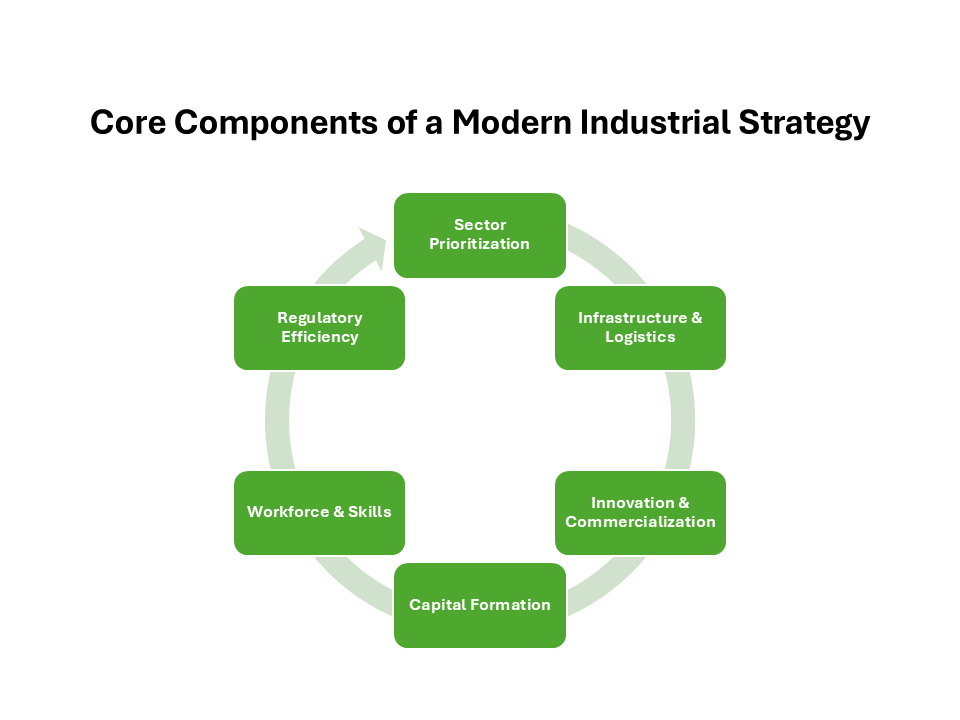
1. Sector Prioritization
Identifying export sectors where Canada has competitive strengths, global demand is rising, and scale is achievable. This anchors both internal and external actions. As part of this process, government and industry should jointly assess the export potential of each priority sector and set realistic, achievable export‑growth targets. These targets help determine how sector‑level gains add up to national gains in GDP, productivity, and long‑term tax‑base growth.
2. Infrastructure & Logistics (Aligned, Not Sequential)
Improvements to ports, rail, energy systems, and digital infrastructure must proceed in parallel with export‑market development. These investments are justified only when they directly accelerate priority export sectors.
3. Innovation & Commercialization (Market‑Facing)
Research and technology efforts must be tied to clear commercial pathways that help Canadian firms compete internationally. Innovation cannot be treated as an internal exercise detached from global markets.
4. Capital Formation (Scaling Exporters Now)
Public and private investment should be aligned to help firms in priority sectors grow and compete internationally. Capital deployment must support immediate export opportunities while building long‑term capacity.
5. Workforce & Skills (Demand‑Driven, Not Abstract)
Education, training, and immigration systems needs to respond to the talent needs of export‑oriented sectors. Skills development must move in lockstep with sector expansion, not years behind it.
6. Regulatory Efficiency (Enabling Real‑Time Growth)
Regulatory systems must reduce delays, duplication, and uncertainty that slow investment and expansion. Streamlining cannot be treated as a prerequisite to export action — it must happen concurrently.
These components are not standalone programs. They are coordinated tools, deployed simultaneously, to expand Canada’s export capacity. When internal reforms and external market actions move together, Canada avoids the drift, delay, and fragmentation that has weakened its competitiveness.
Canada’s economic challenges are not abstract — they are structural, measurable, and the direct result of decades without a coordinated national strategy. If Canada is to rebuild its export capacity and restore long‑term prosperity, the country must move from recognizing the problem to executing a coherent plan.
Industrial Strategy Part 2 outlines how a modern Industrial Strategy can do exactly that: by aligning sectors, capital, skills, infrastructure, and global partnerships into a unified national effort.
If you have not done so already, please review my Legal Stuff page.