“Extremes are easy. The middle is where wisdom lives.”
Reclaiming the Middle
Why Canada’s Broad Middle Is the Key
to Future Prosperity
Introduction
Canada’s political system often behaves as if the country is deeply polarized, even though most Canadians are not.
Beneath the noise, the scandals, and the partisan theatrics, a quieter truth remains: most Canadians live in the broad, pragmatic middle — a place where balanced policy, responsible governance, and long‑term thinking matter most.
Understanding this disconnect is essential if Canada wants to rebuild not only its political culture, but also its economic prosperity.
Many people are familiar with the Pareto Principle, often used to describe patterns in a conceptual way. This post applies a version of that principle to describe the political landscape of Canadian voters and political parties.
A Continuum That Reflects the Real Canada
Imagine Canadian political behaviour as a continuum:
- Far Left (≈10%) — the most ideologically committed Liberal and NDP voters
- Soft Left (≈10%) — left‑leaning but persuadable voters (Liberal–NDP)
- Moderate Centre (≈60%) — independent, pragmatic voters
- Soft Right (≈10%) — right‑leaning but persuadable voters (Conservative)
- Far Right (≈10%) — the most ideologically committed Conservative voters
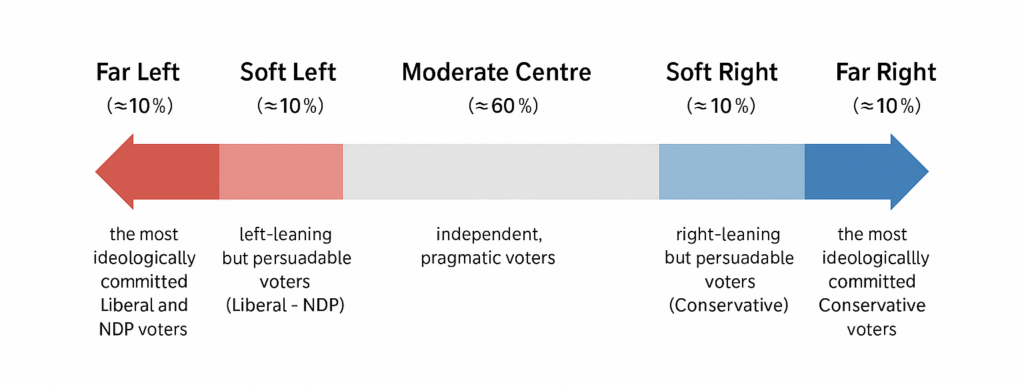
This 10–10–60–10–10 distribution suggests something important: ≈80% of Canadians are persuadable, moderate, and open to voting based on competence rather than ideology.
This is the real centre of gravity in Canadian society — not the extremes, but the broad middle where most people actually live.
The Imbalance: Parties Drifting Away From the Broad Middle
Despite this distribution, Canada’s major parties have positioned themselves away from the middle:
- The Liberal Party has drifted further left of centre.
- The Conservative Party has drifted further right of centre.
- The NDP remains firmly on the far left.
This creates a structural mismatch: the parties that dominate Canadian politics do not sit where most Canadians sit.
When parties drift away from the broad middle, they stop representing the needs of the majority and focus solely on satisfying their bases. The results are predictable:
- ideological posturing instead of strengthening national unity
- politically motivated culture wars instead of sound policy development
- character attacks rather than efforts to find common ground
- skewed economic policies instead of balanced ones
- weak political governance that undermines economic prosperity
This is not just a political problem. It is an economic problem rooted in governance quality.
The Negative Partisanship Trap — and Its Economic Cost
Like many Western democracies, Canada has fallen into a pattern where parties spend more time attacking each other than developing balanced, effective policies.
Scandals, outrage, and discrediting opponents dominate the political conversation. This dynamic has real economic consequences:
- discourages long‑term planning
- weakens investor confidence
- creates costly policy whiplash between elections
- undermines national competitiveness
- distracts from structural issues like productivity, innovation, and affordability
A country cannot build prosperity when its political system is consumed by internal conflict rather than collective problem‑solving.
Why the Broad Middle Matters for Economic Prosperity
The broad middle — the 80% of Canadians who are moderate or near‑moderate — is where balanced, pragmatic policy lives.
When governments straddle this middle, several things happen:
- policies become more stable, reducing uncertainty for businesses and households
- economic planning becomes long‑term, not election‑cycle driven
- fiscal decisions become more responsible, avoiding costly ideological extremes
- regulation becomes predictable, encouraging investment and innovation
- social cohesion strengthens, which is essential for economic confidence
Most Canadian businesses also operate from this broad middle.
They depend on stability, predictability, and competent governance — not ideological swings. The perception that “business = right‑leaning” is largely imported from U.S. politics and does not reflect Canadian reality.
Canadian businesses, especially small and medium‑sized enterprises, overwhelmingly value the same middle‑ground pragmatism that most Canadians do.
In short: Governments that govern from the broad middle create the conditions for sustained economic prosperity. This is not about left versus right. It is about:
- balance versus imbalance
- competence versus chaos
- long‑term prosperity versus short‑term politics
Canada Doesn’t Need to Follow the Pack
Many Western democracies are drifting toward polarization, tribalism, and zero‑sum politics. Canada does not need to follow that path.
Canada can choose a different model — one rooted in:
- the broad middle
- pragmatism
- policy execution rather than performance politics
- a commitment to serving all Canadians
This is how Canada can rebuild trust, strengthen institutions, and restore the conditions for broad‑based economic prosperity.
The Responsibility of the 80%
The persuadable majority — the 80% who are not locked into ideological extremes — holds the real power to reshape Canada’s future.
If they:
- make the effort to vote
- vote thoughtfully
- reward competence
- reject negativity
- demand balanced, middle‑straddling governance
…then Canada’s Liberal and Conservative parties will be forced to move toward the broad middle, where most Canadians actually live.
And when that happens, Canada will be positioned to pursue the kind of long‑term, stable, inclusive economic growth that benefits everyone.
The broad middle is not a compromise. It is a foundation — the path to a more prosperous, confident Canada.
Note: The NDP has been mostly ignored in this post because they are structurally incapable of straddling the broad middle to serve the needs of all Canadians. The Greens have also been excluded because they have yet to establish a strong base in Canada and seem focused primarily on a single issue — the environment.
Eligible Canadians need to vote — and reward competent, balanced governance!
If you have not done so already, please review my Legal Stuff page.